

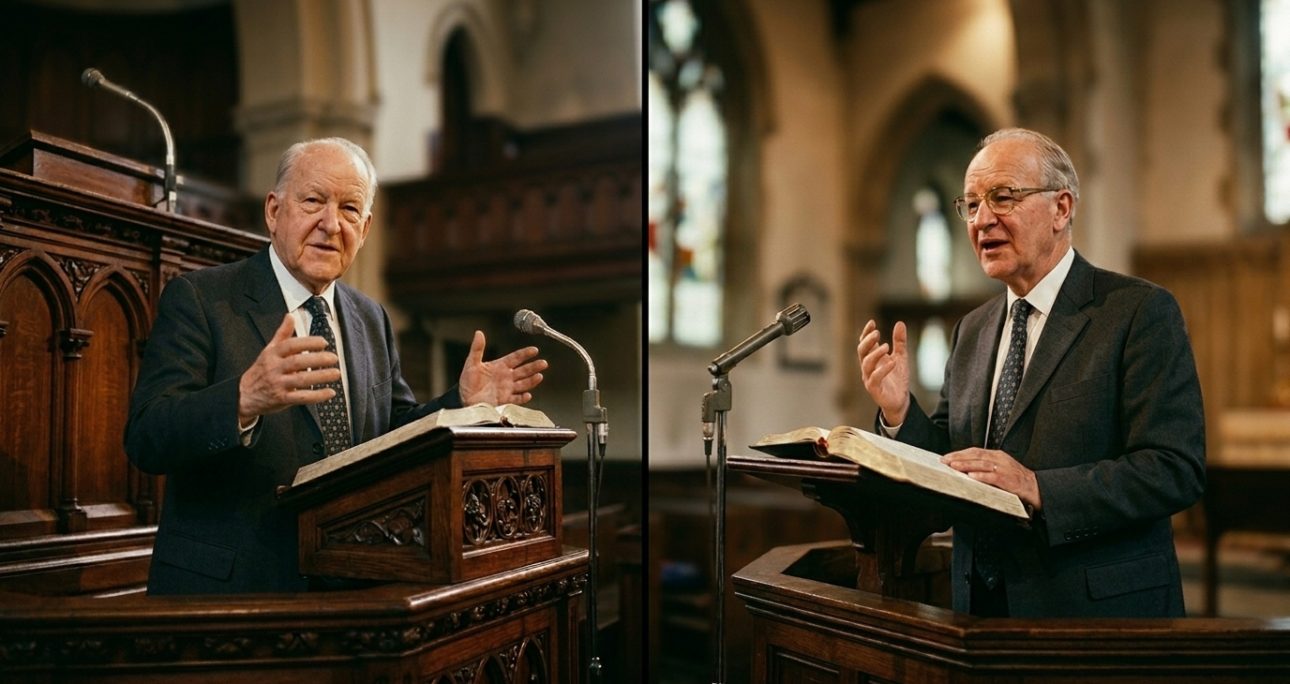
by Han, Ji-Hee
(Ph.D. in Theology, Baekseok University Christian Graduate School)
This study argues that the crisis of preaching in the Korean church is not primarily a methodological problem but a theological one arising from misunderstandings about the relationship between the Word of God and the Holy Spirit. Using the categories of per verbum (“through the Word”), sine verbo (“without the Word”), and cum verbo (“with the Word”), the author analyzes contemporary preaching and compares the preaching models of Martyn Lloyd-Jones and John Stott.
According to the study, Lloyd-Jones viewed preaching as a transformative event in which the Holy Spirit powerfully actualizes the Word of God. His emphasis on the Spirit’s present activity restored a sense of expectation, spiritual power, and personal transformation in preaching. However, this approach can risk placing excessive emphasis on individual experience and subjective responses.
In contrast, John Stott understood preaching as a public act of faithfully interpreting and applying Scripture. Through his well-known concept of “bridge-building” between the biblical world and the contemporary world, he emphasized the authority of Scripture, responsible exegesis, and practical application. Yet an overly explanatory approach may reduce preaching to instruction and information, weakening its transformative and experiential dimensions.
The author therefore proposes a cum verbo perspective, in which the Word and the Spirit are understood as inseparable. In this framework, preaching is neither merely the communication of biblical information nor merely a spiritual experience. Rather, it is a divine event in which the Holy Spirit works through the proclaimed Word to form God’s people. The goal of preaching extends beyond individual change to the formation of the church, the witness of God’s kingdom, and even the restoration of creation.
Ultimately, the study contends that the renewal of preaching in the Korean church will not come through new techniques or communication strategies alone. Instead, it requires a recovery of a Trinitarian understanding of preaching in which the authority of Scripture and the power of the Holy Spirit are held together. Such preaching becomes not only a means of personal edification but also a public testimony through which God transforms both the church and the world.