


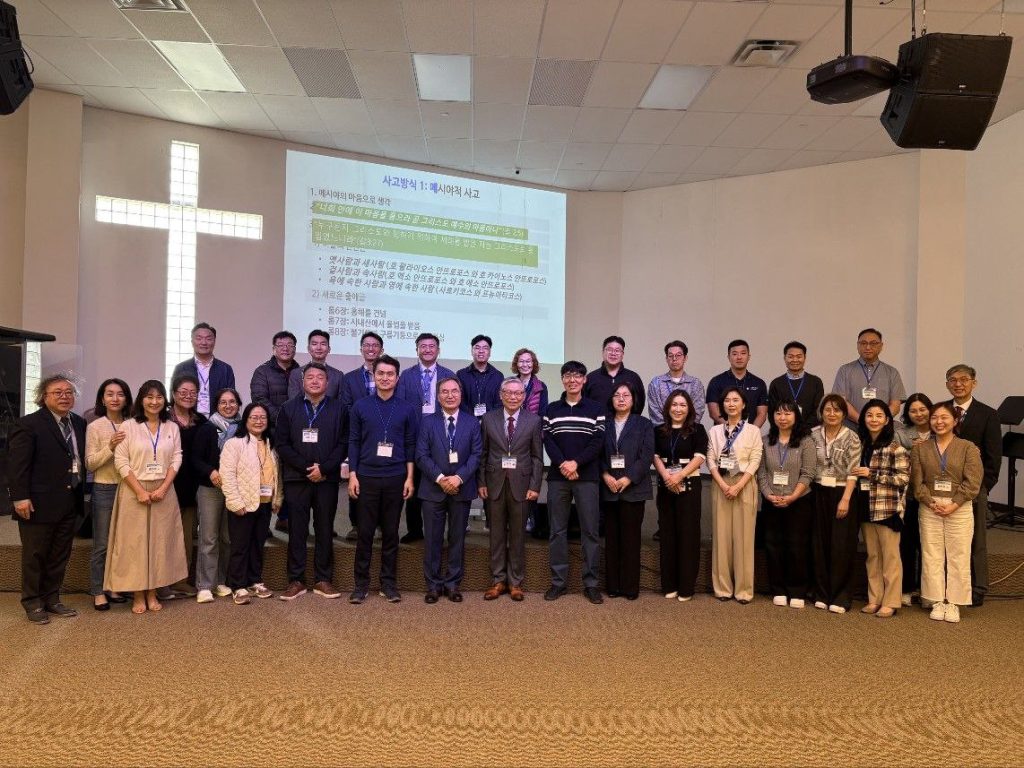
- Overview of the Workshop
From March 26 to April 30, 2026, World Mission University conducted its first One-Point Dramatic Expository Preaching Workshop via Zoom, held every Thursday evening. This six-week training provided a transformative environment for individuals seeking to deepen their love for Scripture and strengthen their preaching ministry.
A total of 30 preachers participated, engaging in a collaborative learning community that transcended the physical limitations of an online format. Through active interaction and shared learning, participants explored new possibilities in dramatic and expository preaching, creating a dynamic platform for both reflection and practice.
- Learning Objectives and Pedagogical Process
The workshop was designed to systematically cover the full process of expository preaching, including exegesis, exposition, and application. Participants progressed step by step from biblical interpretation to message formation and ultimately to sermon delivery.
Through this process, participants developed integrated competencies across the entire spectrum of sermon preparation. First, in the area of Analysis, they learned to carefully observe the biblical text by tracing time, place, events, ideas, and the psychological flow of characters, producing structured exegetical outlines. Second, in Development, they strengthened their ability to derive central theological themes and core messages from the text, establishing clear theological and practical directions for preaching. Third, in Design & Delivery, they applied deductive, inductive, and hybrid sermon structures to construct sermon outlines and enhanced them with vivid narratives and illustrations, thereby improving their effectiveness in communicating the message.
- Key Outcomes
This workshop marked a significant turning point in strengthening participants’ ability to interpret Scripture with accuracy and responsibility. While three major themes were addressed in depth, particular emphasis was placed on the central importance of biblical text analysis.
Participants examined concrete examples of interpretive errors that arise from insufficient understanding of the original meaning, historical background, and cultural context of the text. Through this process, they gained a deeper awareness of how inadequate interpretation can distort the direction and substance of a sermon.
As a result, participants demonstrated a heightened recognition of the necessity of rigorous textual analysis in sermon preparation. Beyond theoretical understanding, they engaged in practical training that enabled them to apply these insights directly to their preaching. Most notably, they reaffirmed that accurate understanding of the biblical text is the decisive factor shaping both the direction and depth of a sermon, and they expressed a clear commitment to applying these principles in their future ministry.
- Participant Feedback and Evaluation Findings
A post-workshop survey revealed significant findings and valuable suggestions:
Positive Impacts:
- Reaffirmation that biblical text analysis is the starting point and core of sermon preparation
- Strengthened awareness of the importance of understanding the text’s original meaning, historical background, and cultural context
- Improved ability to derive central themes and core messages based on text-centered interpretation
- Expansion of contemporary preaching competencies through the integration of AI tools and diverse sermon structures
Recommendations for Improvement:
- Expansion of hands-on practice focused on sermon writing and live delivery
- Strengthening training in interpreting original texts and historical-cultural contexts
- Enhancement of learning support systems, including advance provision of lecture materials
- Increased involvement of external pastors and experts to reinforce practical relevance
- Introduction of small-group, coaching-based models for text analysis and sermon development
- Rebalancing of theoretical and practical components with a structured, step-by-step learning framework
- Conclusion and Future Directions
The 2026 First Preaching Workshop clearly demonstrated that the starting point and core of sermon preparation lies in rigorous biblical text analysis. Participants came to recognize that a proper understanding of the original meaning, historical background, and cultural context fundamentally determines the direction and depth of preaching. This recognition led to a measurable improvement in their ability to derive central theological themes and core messages from the text.
At the same time, the integration of AI tools and diverse sermon structures provided a meaningful opportunity to expand contemporary preaching competencies while maintaining fidelity to traditional expository principles.
The recommendations derived from participant feedback offer concrete guidance for future program development. In particular, expanding practice-based learning, deepening exegetical training, and introducing small-group coaching models are identified as critical factors for enhancing both the practical effectiveness and sustainability of preaching education. Improvements in instructional resources, increased engagement of external experts, and a more balanced integration of theory and practice are also essential for advancing program quality.
Moving forward, WMU plans to further systematize a text-centered preaching education model by strengthening a step-by-step training process that progresses from text analysis to exegesis, expository development, and sermon construction. In addition, the university will expand participatory learning structures centered on practice and coaching while integrating diverse preaching methodologies and technological tools. Through these efforts, WMU seeks to cultivate preachers who remain faithful to the biblical text while effectively responding to the demands of contemporary ministry contexts.